Redox Flow Battery
Plug ‘n Play
Redox flow batteries could mean a breakthrough in electrifying Short Sea shipping. A safe, reliable and cost-effective battery that holds a lot of potential for the future.

100% Recyclable
No degradation
High safety
Elektrolyte fueling
Why use a battery?
Compared to Hydrogen, Methanol, Ammonia or other E-fuels, batteries are way more efficient when looked at the Well to Wake: 1 joule of energy gets you 85% of the energy delivered at the propeller!
Battery
E-Fuels
Trips vs Distance
62% of the Short Sea Shipping market is within reach
Our analysis shows that with a distance of just 500 nautical miles, about 62% of the trips on the short sea shipping market could be completed. This means we could cover the majority of the trips with emission-free shipping.
What is a Redox Flow Battery? (RFB)
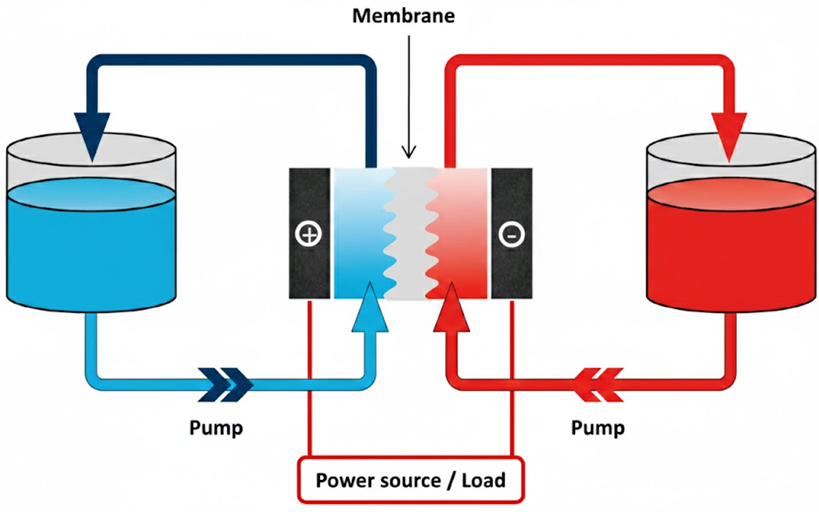
In a Redox Flow Battery, the energy is stored in a liquid, called Electrolyte. This liquid is pumped along a membrane in stacks, where the energy transfer takes place. Because of the properties of a Flow Battery, capacity (KWh) and power (KW) can be independently scaled.
100% Recyclable
Even after 30 years, the electrolyte is fully recyclable
High safety
RFB’s can not have ‘Thermal Runaway’, and are extremely safe to use.
No degradation
Contrary to other battery types, RFB’s don’t lose their capacity.
Refueling
Instead of charging, RFB’s could be refueled with charged elektrolyte.
Why interesting for shipping?
RFBs are extremely suitable for shipping due to their ability to scale energy and power independently. Their long lifespan, minimal degradation, and potential to be refueled instead of recharged makes this a very interesting option for shipping.
Conoship’s Approach
While RFB’s have been around for a while, they have never been used to power ships. To properly assess the feasibility of using an RFB in a ship, Conoship is working closely together with scientists and experts in the field of flow battery technology to bring an idea into reality

1. Desk Research
First, an analysis is made based on the available knowledge to see if the technology is worth researching.
2. Lab test
The technology is being tested thoroughly in a controlled environment to assess the feasibility.

3. Long-term test
After successful lab testing, the technology is taken on board to be proven in practice over an elongated period.
Hexapod Testing
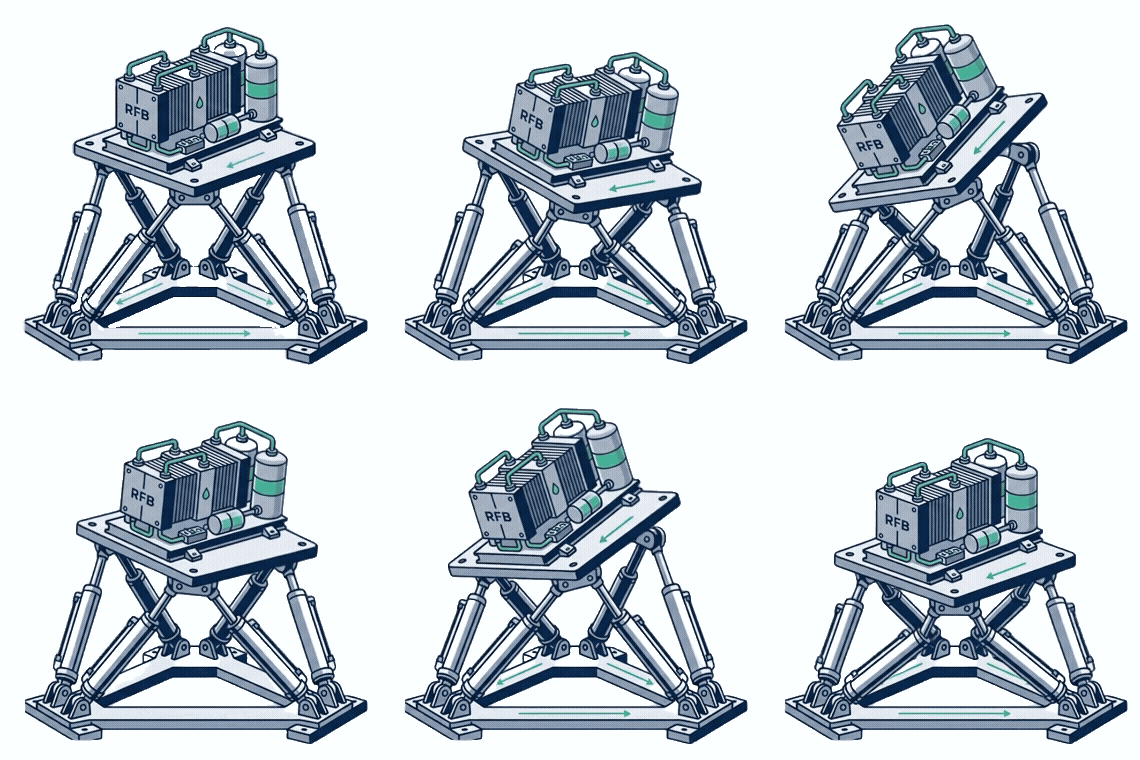
For the first time in the world, Conoship is testing an RFB by simulating maritime environments using a Hexapod. This cutting-edge system replicates the precise accelerations and movements experienced at sea, enabling us to assess the suitability of RFBs in real-world maritime conditions.
Compared to alternatives
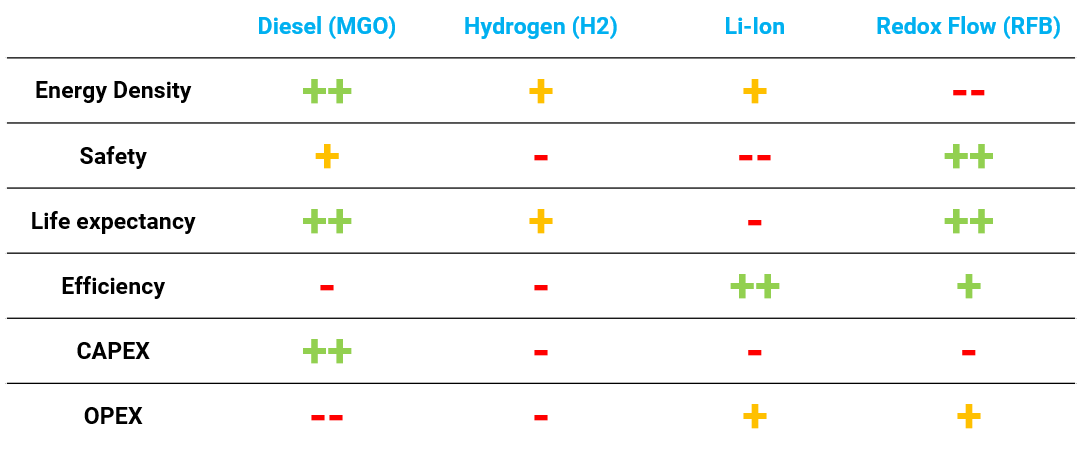
The benefits of Redox Flow technology become immediately clear when compared to alternatives, such as the traditional MGO, hydrogen, or lithium based batteries. The effects of regulation regarding GHG (Greenhouse gasses) has been accounted for in this comparison.
FAQ
That sounds too good to be true. Are there any downsides?
Of course there are. For example, the current energy density of the electrolyte is extremely low, at about 25 Wh/liter. That is way lower than any lithium based battery for example. Furthermore, most RFB’s are currently based on Vanadium Electrolyte (VRFB’s), which is a rare and relatively expensive mineral. Luckily, there is a lot of promising research being conducted to new types of electrolyte.
How does the financing of a Redox Flow battery look like?
The Vanadium cost problem could be tackled by using the full recylability of Vanadium: By treating the Vanadium present in the flow battery as an asset, we could turn the Redox Flow battery in a bankable object. The user is not the owner of the Vanadium in the elektrolyte, but the Vanadium is owned by a third party. The Vanadium then functions as a safe asset, as if it were gold in a safe.
Bankable Vanadium sounds complicated. Any other developments?
Many studies are currently being conducted on organic electrolytes by several research groups, with promising results. Conoship is in contact with many experts in the field to ensure the latest insights in the field for a rapid maturation towards maritime use.
You are a Ship Design Company. Why bother with battery technology?
Conoship believes that it is important to be a frontrunner in Innovation, and sustainability is in the veins of what Conoship believes. For example, Conoship was one of the first companies that started implementing a modular and future-ready design as a standard practice, is experimenting on Carbon Collection, is involved in many hydrogen based projects and is the birthplace of Econowind, pioneers in wind-assisted shipping.
It sounds great, where can I order this battery?
This page is meant to give an overview of the considerations and research that Conoship is conducting. If the outcome of this process is positive, we may take a next step towards an actual commercially available ship using a Redox Flow Battery. Conoship intends to look towards the future and set Zero-emission shipping as the target, how to get there is not carved in stone.
Zero-emission shipping is closer than you think.
Subscribe to our newsletter and get our latest updates right in your mailbox!